

Published on the NEWS on September 8, 2014.
There has been a deluge of recent technological advancements that are creating new air curtain applications that were barely imaginable 10 years ago. Advancements range from more efficient electric heaters to manufacturing improvements that now extend lengths up to 16 feet. Air curtains that were once only custom-manufactured with explosion- and spark-proof components for hazardous industrial locations are now standardized catalog items. What was once an energy-saving device for industrial shipping doors is now embraced by retail, hotel, restaurant, and food service operators as tools for saving energy, eliminating flying insect infiltration, and increasing employee comfort.
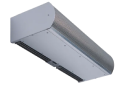
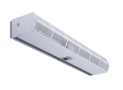
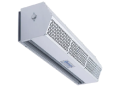
Air curtains, also known as air doors, are typically mounted inside the top of a doorway and continually discharge a steady stream of air down the threshold to separate indoor and outdoor environments. The airstream keeps unwanted cold or hot air from infiltrating an open doorway during winter or summer, respectively. The units also keep out flying insects and maintain a comfortable working environment for employees.
Airstream Efficiency
Air curtains have offered electric heating coil options for decades; however, their traditional mounting in the airstream disrupts the laminar flow that’s critical to its efficacy. Such an obstructing placement can cut airstream efficiency by up to 40 percent. Furthermore, electric heater placements in the airstream disrupt the air curtain’s all-important volume, velocity, and uniformity (VVU), which is critical for maintaining an air seal across the entire doorway for ultimate efficacy.
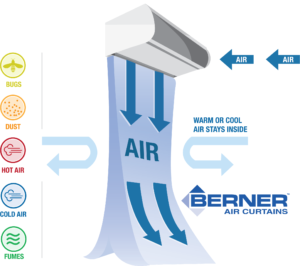
In addition to the discharge air, electric heaters have also been mounted at the inlet screen where air is drawn into the air curtain. While this positioning doesn’t affect the discharge, it’s less energy-efficient because the air curtain enclosure itself becomes heated. This causes up to a 5 percent heat loss radiated through the cabinet that doesn’t reach the targeted area.
One recent invention that has corrected these inefficiencies is the Venturi-style heater, which is a hemispherical electric element array that’s strategically mounted at the air curtain blower’s inlets. Instead of an obstructive mounting in the discharge air, the element’s heat is drawn naturally into the blower via the Venturi effect, which is named for Italian 19th century physicist Giovanni Battista Venturi.
Essentially, the heating element is on the incoming side versus the discharge end of the fan/blower. The result of the Venturi effect heater is an electrically heated air curtain with no discharge obstruction; thus, the air curtain gets nearly 100 percent of the airstream’s aerodynamic potential.
Hazardous Locations
Petroleum refineries, food processing factories, pharmaceutical plants, chemical facilities, compressed natural gas (CNG) bus garages, and other hazardous locations (HL) are restricted by codes that allow only electrical components that are explosion-proof, spark-proof, and abide by other safeguards.
These special processes and environments typically create gases, dust, and other flammable or ignitable elements that can create fires or explosions generated from the spark of an electric motor, contact between ferrous metals, or arcing between electrical connections.
For years, custom-built HL-rated air curtains were available for this type of clientele, but they were custom-manufactured. Now, air curtain manufacturers are offering them as a standardized product line item, which lowers costs significantly and improves availability and lead times.
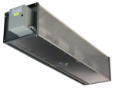
HL applications now offer large door coverage with explosion-proof motors ranging ½ to 15 hp and heavy-duty blowers to protect doorways up to 20 feet tall.
Extending Air Curtain Length
Another standardization of air curtain product lines is length. Previously, doorways wider than 12 feet typically had modular units bolted together or custom-made single-unit constructed air curtains, the latter of which carried expensive manufacturing costs. However, new technological manufacturing advancements make 16-foot lengths possible as standardized catalog items for some manufacturers. Industrial doorways commonly span widths of 12-16 feet.
The important aspect of single-unit construction is installation ease and performance. In comparison to multiple short units bolted together, single-construction air curtains typically don’t need intermediate supports, which can increase installation time and costs. Furthermore, the space between bolted units typically creates air voids. Single-construction units designed for 16-foot lengths use blower and nozzle airstream widths that cover the entire span without any interruption or turbulence. The VVU of the airstream, which can only be accomplished with a single-construction unit, is critical to air curtain performance and efficacy.
Air Curtains Substituting for Vestibules
Recent updates to the 2015 International Energy Conservation Code (IECC), which is published by the International Code Council (ICC), will now allow certified air curtains as a vestibule alternative. This is good news for commercial buildings that, in the past, were mandated to use vestibules as energy-saving airlocks.
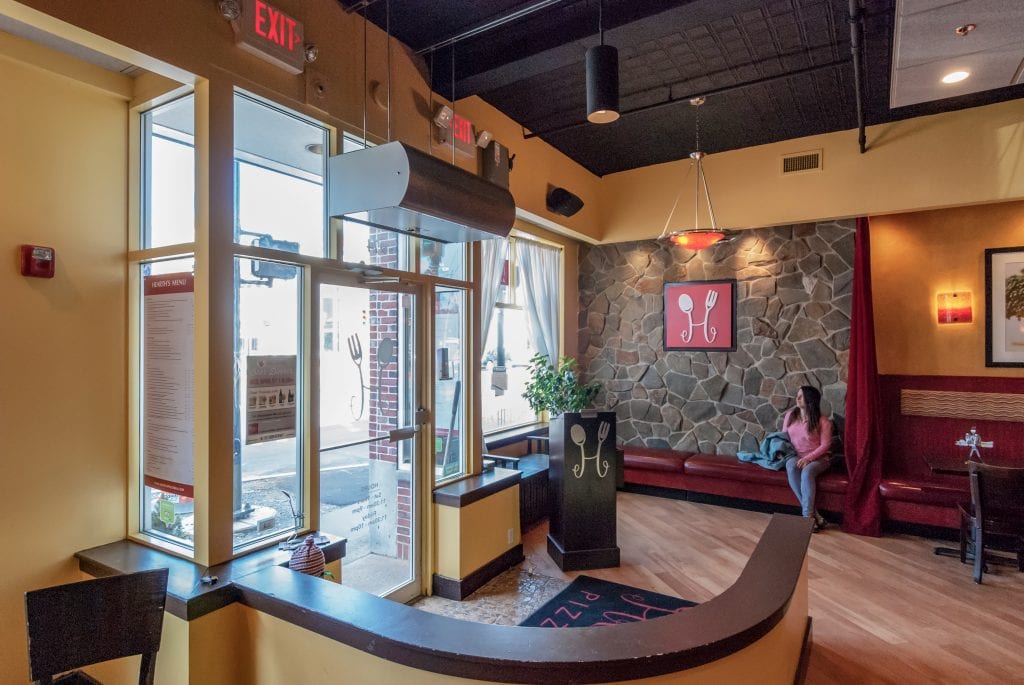
This code change offers both a new construction and a retrofit perspective, especially for retailers. In retrofit examples, installing an air curtain and using the vestibule for merchandising space can add to a retailer’s bottom line.
The 2015 IECC code also stipulates air curtains must be tested in accordance with standard ANSI/AMCA-220 and certified by the Air Movement and Control Association Intl. Inc. (AMCA), a not-for-profit organization that tests and certifies manufacturers’ stated performance of fans, blowers, air curtains, and other air movement devices.
Food Service Applications
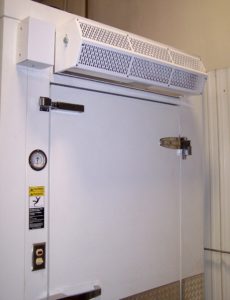
Walk-in cooler air curtains have been shown to surpass the energy-saving potential of alternatives, such as swinging hinged doors and strip curtains, and they produce a quick payback of less than two years, depending on the number of door cycles. While they are now predominantly appearing as options on new models from walk-in cooler manufacturers, several air curtain suppliers make retrofitting easy with a kit that includes an air curtain designed specifically for the unique size and configuration of walk-in coolers. Included in some kits are a prewired 24-V control/load center in a small enclosure and a magnetic reed on-off door switch. Once 120-V power is extended to the area, the prewired kit can be installed in as little as 15 minutes with conventional tools and basic electrical knowledge.
Besides walk-in coolers, another trend in the food service and restaurant industries is the use of drive-thru window air curtains, which are being used for a variety of purposes in many restaurant chains. They minimize both flying insect and outdoor air infiltration and protect the indoor drive-thru station employee from idling vehicle fume inhalation as well as cold air in winter climates, which are employee health and comfort issues, respectively. The U.S. Department of Labor’s Occupational Safety and Health Administration (OSHA) specifically recommends a “reverse-flow fan system” at its “Teen Worker Safety in Restaurants” page.
As technological advancements move forward, even more new air curtain applications are expected to emerge. What is barely imaginable today may soon become common building construction concepts in the future.
The IECC and IgCC building codes list AMCA certified air curtains as viable alternatives to vestibules.
Learn more about Berner’s AMCA certified air curtains.
Berner is excited to provide more heat options when using air curtains as an alternative to vestibules. In addition to adding AMCA Certified heating options, Berner also recently launched the Berner Air Curtain App to control architectural air curtains from a smartphone.
AMCA Certification for Heat
Berner received product performance certifications by the Air Movement & Control Association International (AMCA), Arlington Heights, Ill., in June for heating options on two of its designer air curtain series and in the autumn, for the heated version of the Commercial High Performance 10 air curtain.
While Berner has offered AMCA certified ambient models for decades, now specifying engineers have the option of heat when selecting models to comply with the International Energy Conservation Code’s (IECC) Section C402.4.7, building code which allows AMCA certified air curtains as exceptions to entrance vestibules.
AMCA tested under AMCA Standard 220 steam, hot water, and electric coil heating options on the following Berner air curtains:
- Architectural High Performance 10 Series
- Architectural Recessed 12 Series
- Commercial High Performance 10 Series
“AMCA believes that products should be tested and published per engineering standards and rating requirements,” said Nazme Mohsina, Associate Director of Certification, AMCA International. “With AMCA certified products, engineers can have confidence that manufacturers’ ratings are accurate, and that the catalog data are formatted to facilitate product comparisons across manufacturers.”
Berner Air Curtains
While Berner air curtains prevent outdoor temperature, dust, and flying insect infiltration, the certified heating additions reassure specifiers that Berner’s air curtains enhance occupant air comfort in cold weather situations. Berner’s wall-mounted and recessed architectural units with or without heat are aesthetic, energy-saving mechanical air devices designed to separate outdoor/indoor environments. Air curtains are used at door openings in lobbies, welcome areas, and other front-of-house areas in restaurants, hotels, retail stores, hospitals, and other buildings to keep people comfortable and save energy.
Berner was instrumental in helping AMCA push through building code International Energy Conservation Code’s (IECC) Section C402.4.7, the recent vestibule exception allowance. The International Code Council’s (ICC) International Green Building Code (IgCC) also allows the use of air curtains instead of commercial building vestibules. This could potentially save building owners tens of thousands of dollars in new construction costs while also freeing up more useful square footage.
Heating Options
While other manufacturers offer AMCA certification on a limited number of electrically heated models, Berner is the only manufacturer to offer steam and hot water coil heating options in addition to its patented VTH Venturi-style electric heater. Introduced and patented by Berner in 2010, the VTH is the HVAC industry’s most aerodynamically efficient electric heater. It uses the Venturi effect to draw air through the heating element via the blower inlet before it enters the discharge air stream. This results in an unobstructed, near 100% efficient full laminar air stream discharge velocity with efficiency improvements of up to 40% versus heating coils placed in the discharge.
“By adding AMCA certified heated options to our most popular designer air curtains, engineers have more choices in how they both meet the IECC building code regarding main entrances and provide comfort to the space around the door,” said Georgia Berner, president, helped establish the 62-year-old, not-for-profit AMCA as a third-party testing resource for air curtains in the late 1970’s and early 1980’s.
Certifications & Building Codes – click here for more information IECC code change adding air curtains as an exception to a vestibule.
Berner Air Curtain App – learn more here.
Commercial High Performance 10 Series Air Curtains Meet IECC Requirements for Heated and Unheated Alternatives to Vestibules
This series is designed to meet functional needs while also integrating seamlessly into its surrounding environment to be an AMCA-certified option for engineers and architects to separate indoor and outdoor environments easily and efficiently.
New Castle, PA – June 11, 2018 – Berner’s recently-introduced Commercial High Performance 10 Series (CHD10) air curtain has been certified for electric heat by the Air Movement & Control Association (AMCA).
The Commercial High Performance 10 Series joins Berner’s Architectural High Performance 10 (AHD10) and Architectural Recessed 12 (ARD12) air curtains in offering architects and engineers AMCA-certified heated and unheated choices to replace vestibules in building projects as per allowances by the International Energy Conservation Code’s (IECC) Section C402.4.7, under “Building Envelope Requirements”. This allowance eliminates the construction costs and wasteful footprint of vestibules, while also providing equal or better energy efficiency and occupancy comfort.
Berner’s Venturi Heater
The superior performance of the Commercial High Performance 10 Series’ AMCA-certified heat is partially due to Berner’s patented Venturi heater, the air curtain industry’s most efficient electric heater. Berner air curtains with the Venturi heaters outperform other air curtains with electric heaters due to a more efficient design as well as the placement of the heater. The Venturi heater is mounted on the incoming airside of the blower wheel, warming the air without interfering with the air movement. Other manufacturers’ designs place the electric heater in the discharge airstream, which interrupts an air curtain’s laminar airflow and performance efficiency.
Vestibule Alternative
The AMCA certification on heated models gives designers more IECC building code compliant options when specifying air curtains instead of a vestibule. The Commercial High Performance 10 Series’ heat and airflow performance is comparable to Berner’s premium Architectural Category of heated high performance and in-ceiling mount air curtains. However, the Commercial High Performance 10 Series is an economical alternative for applications not requiring premium features, such as a higher level of aesthetics, Berner’s patented Intelliswitch™ digital control package, or access control via a smartphone. The heated Commercial High Performance 10 Series does come with Berner’s Basic Control Package that can be upgraded to the Deluxe Package for a time delay; or the Comfort plus for time delay and thermostatically controlled air comfort even when the door is closed.
The Commercial High Performance 10 Series’ attractive CNNC-cut decorative grille and aesthetic, pentagonal-shaped cabinet come powder-coated in standard white or black. Due to Berner’s in-house powder coating capabilities, custom colors are also an option, such as stainless steel, grade 304 or better.
Other features of the Commercial High Performance 10 Series with electric heat are:
- effective prevention of flying insect infiltration and energy losses through open doorways;
- UL and cUL listed, USDA-compliant, and FDA-recommended;
- no assembly required – units are manufactured in single construction lengths of up to 10-feet-long, and shipped fully assembled, which reduces installation time and labor;
- a five-year parts warranty for unheated models and a two-year parts warranty for heated models.
Learn more about Berner’s AMCA certified air curtains by calling (724)658-3551; visiting www.Berner.com; or emailing sales@berner.com