
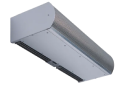
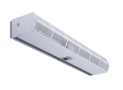
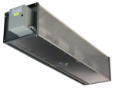
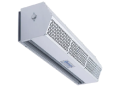

Air curtains prevent flying insects and discourage seagulls from concession areas at the Pensacola Bay Front Stadium to help maintain high standard for food sanitation.
Pensacola, Fla. – It’s now a fact: air curtains at baseball stadiums are for the birds. That was the local health inspectors’ philosophy when they mandated air curtains to deter pesky seagulls at the Florida Panhandle’s $15 million Pensacola Bayfront Stadium, which sits just 50 yards from the ocean.
Air curtains are designed to conserve energy and prevent flying insect and dust infiltration, not to discourage three-pound birds flying at 20 mph. However, after several months and more than 60 ballgames, the inspectors were proven correct. Not one seagull ventured past the eight air curtains protecting two separate 3,600-square-foot food preparation and service concession areas at the home of the Pensacola Blue Wahoos, then the Cincinnati Reds’ new AA Southern League affiliate.
No one was more thrilled about the local code than the concession areas’ designer, Matt Morel, FCSI, who has designed renowned outdoor sports venues such as Salt River Fields in Scottsdale, Ariz., and Major League Soccer’s PPL Park in Chester, Pa. Morel, a project manager for Ovations Food Services, Lutz, Fla., a foodservice design and management company specializing in convention, fair, gaming and sports venues, routinely specifies air curtains for flying insect prevention when budgets permit. Pensacola’s health code ruling, which mandates bird deterrents for any oceanfront foodservice venue, guaranteed Morel could budget air curtains to maintain sanitation in his foodservice design.
Read the full case study in the PDF below to see how air curtains keep the Blue Wahoos’ concession areas sanitary all season.
Learn more about Berner air curtains for concession windows.
Vertical air curtain combined with existing high-speed roll-up door cuts thousands of dollars in monthly energy and maintenance costs for an eastern Ohio food processor.
Columbus, Ohio – When an eastern Ohio food processor sought to curb high energy losses and icing maintenance costs at its cold storage freezer doorway, industrial door equipment dealer Fairborn Equipment Co. of Ohio solved the challenge with a customized air curtain installation.
Fairborn, a distributor of loading dock, industrial door and specialty industrial plant products, reviewed several technology options to solve its food manufacturing client’s doorway energy and maintenance challenges.
The client had already installed a high-speed, insulated roll-up door that reduced the escape of -5°F freezer air and the infiltration of 60°F to 95°F summertime ambient air from the shipping door area 50 feet away. Despite the high-speed door, humid ambient air still infiltrated through the top of the 12 x 12-foot doorway during its hundreds of daily cycles. The greatest concern was an 8-degree freezer temperature fluctuation, which was unacceptable under the client’s standards for product quality, refrigeration equipment wear-and-tear and energy conservation.
The significant energy losses are no surprise. The refrigeration handbook of the American Society of Heating, Refrigerating and Air-Conditioning Engineers (ASHRAE) states that air infiltration through open doorways is the leading cause of increased refrigeration loads at cold storage facilities. Bob Hare, general manager of Fairborn’s Columbus office, estimated his client’s energy losses and maintenance costs combined amounted to thousands of dollars per month.
Besides energy losses, humidity infiltration also required periodic ice removal from the ceiling-hung ammonia refrigeration system’s piping, coils, valves and controls just inside the 20,000-square-foot freezer’s doorway. The fire door roller tracks were also continually iced. Additionally, icy floors near the threshold created the potential for forklift accidents and required ongoing maintenance.
Find out how Fairborn’s custom air curtain installation solved this freezer doorway’s icing and energy problems. Read the full case study in the PDF below.
Try out Berner’s Energy Savings Calculator to see what you could be saving by installing a Berner air curtain.
Have a custom air curtain installation? Contact Berner Air Curtains for assistance.
Milking parlors on dairy farms are yet another application for air curtains. Combined with other energy efficient technologies, air curtains save Griesen’s Family Dairy an estimated $35,000 annually.
Learn more about Berner’s line of Industrial and Hazardous Location Series Air Curtains.
Engineers’ novel rollup doors retrofit with air doors (fly fans) stops plant’s flying insect ingress.
Learn more about Berner’s line of Industrial air curtains.
Posted on ContractedBusiness.com, July 26, 2012
Air curtains at baseball stadiums are for the birds. That was the local health inspectors’ philosophy when they mandated air curtains to deter pesky seagulls at the Florida panhandle’s new $18 million Pensacola Bay Front Stadium that’s merely 50 yards from the ocean.
Air curtains are designed to conserve energy and prevent flying insect and dust infiltration, not discourage three-pound birds flying at 20 mph. However, after several months and more than 60 ballgames, the inspectors were correct. Not one seagull has ventured past eight air curtains that protect two separate 3,600-sq.ft. food preparation and service concession areas at the home of Cincinnati Reds new AA Southern League affiliate, the Pensacola Blue Wahoos.
No one was more thrilled about the local code than the concession areas’ designer, Matt Morel, FCSI, who has designed renowned outdoor sports venues such as Salt River Fields, Scottsdale, Ariz., and Major League Soccer stadium PPL Park, Chester, Pa. Morel, a project manager for Ovations Food Services, Lutz, Fla., a foodservice design and management company specializing in convention, fair, gaming, and sports venues, routinely specifies air curtains for flying insect prevention when budgets permit. Therefore Pensacola’s local health code ruling, which mandates bird deterrents for any oceanfront foodservice venue, guaranteed Morel could budget air curtains to maintain sanitation for his cutting-edge quality foodservice design.
Keeping it Fresh
The fresh-cooked food combined with state-of-the-art kitchen prep areas that are unobstructed and open for public viewing
Pleasing Aesthetics

The air curtain finish matches its roll-up door surroundings and offers an aesthetically modern built-in appearance, versus the other code-satisfying alternatives–an uninviting closed wall/door obstruction around the concession areas or 50 temporary floor-standing oscillating fans. Neither alternative environmentally seals a doorway from flying insects with a curtain of air, according to Morel.
The air curtains in the two main 360-square-foot pedestrian concession entrances are only five feet from food and money transactions. Therefore, Mark Micallef, Ovations’ onsite director of food and beverage, finds the medium fan speed strong enough to thwart flying insects, but not strong enough to blow beer or popcorn out of containers and paper money out of hands. Ballpark concessions rarely include air conditioning because of their openness, therefore the nearby air curtains also offer a slight residual ventilation benefit to foodservice workers.
“The air curtains offer some ventilation relief to foodservice workers on hot, humid Florida days.”
— Micallef, who previously managed Ovations concessions at The Everbank Field, Jacksonville, Fla.; Salt River Fields, Scottsdale, Ariz.; and Provident Bank Park, Rockland, N.Y.
State-of-the-Art
While minor league baseball venues are typically stereotyped as sterile, no-frill atmospheres, owner Pensacola Community Maritime Park Associates and general contractor Hoar Construction, Orlando, Fla., have created a lively, upbeat, cutting-edge stadium. The concourse is lined with dozens of digital flat screen televisions, the field boasts digital line-up boards and digital ad boards, plus the outfield high definition video scoreboard rivals many Major League ballparks.
The kitchen design and equipment are equally high tech and displayed in full view behind the belly-up counters as well as through the main cooking areas’ windows, which were purposely built into the design to showcase the high tech foodservice operation. Like the air curtains, Morel specified some of the foodservice equipment industry’s cutting-edge brands, such as Dean Fryers by Frymaster L.L.C., Shreveport, La.; beer systems by Chill-Rite/Desco Inc., Slidell, La.; portable carts by Corsair Display Systems, Canandaigua, N.Y.; ovens and stoves by Bakers Pride Oven Co., New Rochelle, N.Y.; exhaust hoods by Accurex, Schofield, Wis.; and soft-serve ice cream machines by Stoelting, Kiel, Wis.
“I’m a proponent of anything that prevents flying insects near the food and its preparation, and especially at ballparks which have many insect-attracting sweets such as cotton candy, ice cream and popcorn.”
— Morel, 14-year industry veteran & former foodservice designer for Darden Restaurants’ Olive Garden chain
Thanks to Ovations’ attention to quality and sanitation, the only fish the seagulls and flying insects approach are in Pensacola Bay.
Velocity, Volume, and Uniformity
Velocity, volume, and uniformity work together to create the ideal air curtain performance, therefore relying on only one or two of three could skew performance results.
Velocity: To properly design an air curtain installation, the airstream must hit the floor with enough velocity to create a split. The split, which creates stability, strength, and direction for the air entrained on each side of the airstream, should occur right at the doorway’s threshold. An installation with a weak airstream, one that barely splits, for example, is only viable for applications involving temperature differential without wind, such as internal doorways. They’re capable of stopping infiltration or cross-contamination of environments due to airflow caused by the temperature differential, but they become ineffective once wind is introduced. Few external doorways are not affected by wind loads.
Volume: Volume, on the other hand, is the building block that allows a properly designed and pressurized discharge plenum to generate a high-velocity laminar jet stream. The taller the opening, the more volume that is required to generate a thicker, higher velocity airstream to resist wind loads of four to five mph. Obviously, an air curtain for a fast food restaurant’s drive-through window doesn’t need as strong a volume as a 16-foot high door in a shipping area. Once an air curtain activates and creates a split, it creates a “skin” over the building’s volume of indoor air and uses this internal pressure to resist wind. The split then rolls the entrained conditioned and unconditioned air back to their respective areas.
Uniformity: Another important factor to consider in air curtain performance and selection is uniformity, which only impacts the airstream effectiveness when it drops below 75%. An air curtain that focuses too much energy on generating a high uniformity loses velocity, therefore reducing its effective wind resistance.
Bringing in the great outdoors with retractable windows and air curtains boosted the grill & bar’s sales by 25-30%
Learn more about Berner’s line of Commercial and Industrial air curtains
Employees now work in a warm, comfortable environment, but equally important are the energy savings.
Royal Wine’s food processing and distribution center responded to employee wintertime requests for a warmer shipping area, and received a bonus when the six dock door air curtains installed for air comfort also significantly reduced operational energy costs.
Sub-freezing days near open shipping doors previously required heavy clothing, hampered worker productivity and caused chilling drafts despite portable truck and dock seals, according to Abraham Wechter, plant engineer, Royal Wine Corp., Bayonne, N.J.
Royal Wine, the world’s leading kosher winemaker, imports and produces more than 60 brands of wine, manufactures the renowned Kedem fruit juice brand, and operates Herzog Wine Cellars with vineyards in Oxnard, California.
Learn how six dock door air curtains kept Royal Wine employees warm and cut energy costs. Read the full case study in the PDF below.
Try out Berner’s Energy Savings Calculator to see what you could be saving by installing a Berner air curtain.
Learn more about Berner’s line of Industrial air curtains.
In a competitive auto retailing economy, car dealerships always look for a competitive edge. Mel Grata Chevrolet/Toyota has found climate-controlled indoor air comfort greatly improves customer satisfaction especially during cold Pennsylvania winters.
Mel Grata Chevrolet/Toyota’s new green service bay buildings in Hermitage, Pa., save energy while keeping employees and customers warm.
In a competitive auto retailing economy, car dealerships are always looking for an edge, and Mel Grata Chevrolet/Toyota has found that climate-controlled indoor air comfort greatly improves customer satisfaction, especially during cold Pennsylvania winters.
Instead of fighting inclement weather, Mel Grata customers now drive through one of two new climate-controlled service/staging areas featuring doorway air curtains. The air curtains, also referred to as “air doors,” efficiently separate the indoor and outdoor environments and maintain indoor temperatures, even with constant door openings during morning rush hours.
The Chevrolet service area was expanded into a 2,000-square-foot, newly remodeled three-bay space. The separate 1,500-square-foot Toyota service area is a recently built two-bay, four-door space. Both buildings adjoin the dealership’s main 75,000-square-foot showroom and office complex. Industrial Direct Drive 12 Series air curtains with three-speed motors, manufactured by Berner International, New Castle, Pa., seal each of the seven 12 x 12-foot doorways with a controlled airstream to protect against outdoor air infiltration during hundreds of daily door cycles.
“Without the air curtains, it would take several minutes for the heating system to recover our 70°F set point temperature that keeps customers and employees comfortable,” said President Mel Grata, who conceived of the idea after seeing air curtains in action on truck docks, vestibules and retail store entrances.
“We’ve had no air comfort complaints from customers or employees even on the coldest winter days, and that’s good for business,” said Grata.
— Mel Grata, President, Mel Grata Chevrolet/Toyota