
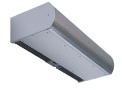
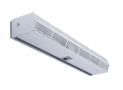
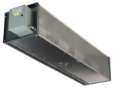
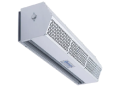

Air curtains help Chicago’s new McCormick Place West save $70,000 annually with an equipment payback of under two years.
Try out Berner’s Energy Savings Calculator to see what you could be saving with a Berner air curtain.
Detroit auto dealership, Moran Chevrolet, nets nearly a $7,000 energy savings and short seven-month payback with increased employee air comfort after installation of Berner’s Industrial Direct Drive 14 air curtain.
Learn more about Berner’s line of industrial air curtains.
Published on the NEWS on September 8, 2014.
There has been a deluge of recent technological advancements that are creating new air curtain applications that were barely imaginable 10 years ago. Advancements range from more efficient electric heaters to manufacturing improvements that now extend lengths up to 16 feet. Air curtains that were once only custom-manufactured with explosion- and spark-proof components for hazardous industrial locations are now standardized catalog items. What was once an energy-saving device for industrial shipping doors is now embraced by retail, hotel, restaurant, and food service operators as tools for saving energy, eliminating flying insect infiltration, and increasing employee comfort.
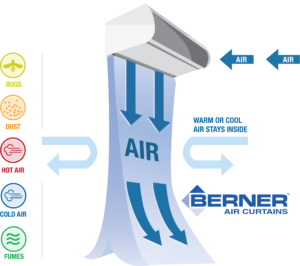
Air curtains, also known as air doors, are typically mounted inside the top of a doorway and continually discharge a steady stream of air down the threshold to separate indoor and outdoor environments. The airstream keeps unwanted cold or hot air from infiltrating an open doorway during winter or summer, respectively. The units also keep out flying insects and maintain a comfortable working environment for employees.
Airstream Efficiency
Air curtains have offered electric heating coil options for decades; however, their traditional mounting in the airstream disrupts the laminar flow that’s critical to its efficacy. Such an obstructing placement can cut airstream efficiency by up to 40 percent. Furthermore, electric heater placements in the airstream disrupt the air curtain’s all-important volume, velocity, and uniformity (VVU), which is critical for maintaining an air seal across the entire doorway for ultimate efficacy.
In addition to the discharge air, electric heaters have also been mounted at the inlet screen where air is drawn into the air curtain. While this positioning doesn’t affect the discharge, it’s less energy-efficient because the air curtain enclosure itself becomes heated. This causes up to a 5 percent heat loss radiated through the cabinet that doesn’t reach the targeted area.
One recent invention that has corrected these inefficiencies is the Venturi-style heater, which is a hemispherical electric element array that’s strategically mounted at the air curtain blower’s inlets. Instead of an obstructive mounting in the discharge air, the element’s heat is drawn naturally into the blower via the Venturi effect, which is named for Italian 19th century physicist Giovanni Battista Venturi.
Essentially, the heating element is on the incoming side versus the discharge end of the fan/blower. The result of the Venturi effect heater is an electrically heated air curtain with no discharge obstruction; thus, the air curtain gets nearly 100 percent of the airstream’s aerodynamic potential.
Hazardous Locations
Petroleum refineries, food processing factories, pharmaceutical plants, chemical facilities, compressed natural gas (CNG) bus garages, and other hazardous locations (HL) are restricted by codes that allow only electrical components that are explosion-proof, spark-proof, and abide by other safeguards.
These special processes and environments typically create gases, dust, and other flammable or ignitable elements that can create fires or explosions generated from the spark of an electric motor, contact between ferrous metals, or arcing between electrical connections.
For years, custom-built HL-rated air curtains were available for this type of clientele, but they were custom-manufactured. Now, air curtain manufacturers are offering them as a standardized product line item, which lowers costs significantly and improves availability and lead times.
HL applications now offer large door coverage with explosion-proof motors ranging ½ to 15 hp and heavy-duty blowers to protect doorways up to 20 feet tall.
Extending Air Curtain Length
Another standardization of air curtain product lines is length. Previously, doorways wider than 12 feet typically had modular units bolted together or custom-made single-unit constructed air curtains, the latter of which carried expensive manufacturing costs. However, new technological manufacturing advancements make 16-foot lengths possible as standardized catalog items for some manufacturers. Industrial doorways commonly span widths of 12-16 feet.
The important aspect of single-unit construction is installation ease and performance. In comparison to multiple short units bolted together, single-construction air curtains typically don’t need intermediate supports, which can increase installation time and costs. Furthermore, the space between bolted units typically creates air voids. Single-construction units designed for 16-foot lengths use blower and nozzle airstream widths that cover the entire span without any interruption or turbulence. The VVU of the airstream, which can only be accomplished with a single-construction unit, is critical to air curtain performance and efficacy.
Air Curtains Substituting for Vestibules
Recent updates to the 2015 International Energy Conservation Code (IECC), which is published by the International Code Council (ICC), will now allow certified air curtains as a vestibule alternative. This is good news for commercial buildings that, in the past, were mandated to use vestibules as energy-saving airlocks.
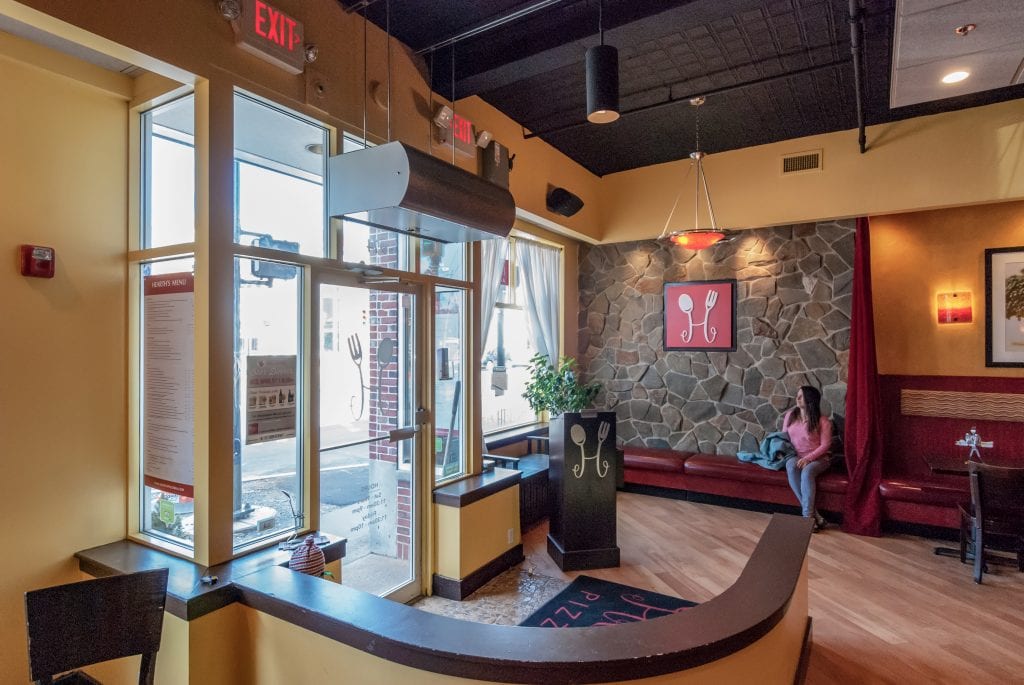
This code change offers both a new construction and a retrofit perspective, especially for retailers. In retrofit examples, installing an air curtain and using the vestibule for merchandising space can add to a retailer’s bottom line.
The 2015 IECC code also stipulates air curtains must be tested in accordance with standard ANSI/AMCA-220 and certified by the Air Movement and Control Association Intl. Inc. (AMCA), a not-for-profit organization that tests and certifies manufacturers’ stated performance of fans, blowers, air curtains, and other air movement devices.
Food Service Applications
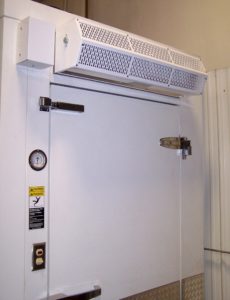
Walk-in cooler air curtains have been shown to surpass the energy-saving potential of alternatives, such as swinging hinged doors and strip curtains, and they produce a quick payback of less than two years, depending on the number of door cycles. While they are now predominantly appearing as options on new models from walk-in cooler manufacturers, several air curtain suppliers make retrofitting easy with a kit that includes an air curtain designed specifically for the unique size and configuration of walk-in coolers. Included in some kits are a prewired 24-V control/load center in a small enclosure and a magnetic reed on-off door switch. Once 120-V power is extended to the area, the prewired kit can be installed in as little as 15 minutes with conventional tools and basic electrical knowledge.
Besides walk-in coolers, another trend in the food service and restaurant industries is the use of drive-thru window air curtains, which are being used for a variety of purposes in many restaurant chains. They minimize both flying insect and outdoor air infiltration and protect the indoor drive-thru station employee from idling vehicle fume inhalation as well as cold air in winter climates, which are employee health and comfort issues, respectively. The U.S. Department of Labor’s Occupational Safety and Health Administration (OSHA) specifically recommends a “reverse-flow fan system” at its “Teen Worker Safety in Restaurants” page.
As technological advancements move forward, even more new air curtain applications are expected to emerge. What is barely imaginable today may soon become common building construction concepts in the future.
Published on the NEWS on April 22, 2013
Whether it’s a wintery 20°F or a steamy summer day, the front doors are always propped open at Fortunes Coffee Roastery in Pittsburgh’s Strip District. One of the first policy changes store manager Paula Sciullo made after her family bought the 20-year-old independent coffee retailer last year was an “always open” door policy as a welcoming gesture to passersby. Situated on the mile-long wholesale-food area near downtown Pittsburgh, the coffee shop is nestled in with specialty shopping and nightlife establishments.
Since patrons are an even mix of impulse and destination shoppers, the sales results were immediate. Foot traffic into the 1,200-square-foot store increased dramatically, by 20-30 percent. That increase in foot traffic was accompanied by a similar increase in sales, Sciullo said.
“Just about everyone who comes through the door buys something, so any strategy, such as an open door, can reap benefits,” Sciullo added.
But how does Scuillo maintain a comfortable indoor environment while keeping her door wide open to the wildly fluctuating Pittsburgh weather? By using an air curtain to create an invisible wall of air that keeps the outside elements — including dust, exhaust, and insects — outside while keeping the inside environment consistent and comfortable.
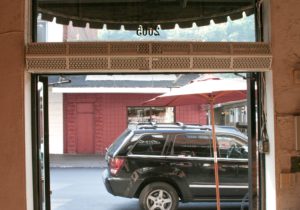
Scuillo installed a Zephyr air curtain manufactured by Berner Intl., New Castle, Pa., above the doorway in order to minimize energy losses and maintain indoor air comfort within 3-5°F of indoor set-point temperatures. The Zephyr helped maintain a consistent and comfortable environment for employees and patrons alike near the point-of-purchase entrance area.
Curtain Call
Air curtains aren’t a new innovation — they’ve been used for decades in industrial applications. However, retail stores — from convenience stores and apparel outlets to large drug stores and big-box merchants — are now using air curtains to reduce energy losses and increase indoor comfort in both front- and back-end doors. Most recently, retailers are circumventing the huge costs of constructing vestibules by instead combining air curtains with automatic doors, which studies last year proved are far more efficient than the traditional vestibule.
Sciullo’s father recommended air curtain technology for the store because he has bought and used them for decades in his own industrial material-handling, warehousing, and trucking-dock businesses.
The 72-inch-wide Zephyr air curtain is designed to strategically discharge air from 8 feet above the doorway down to the floor and split a few inches outside the threshold. Proper air velocity, volume, and uniformity will successfully separate the indoor and outdoor environments. Outdoor air, vehicle-emission fumes, and insects can’t penetrate a properly designed, manufactured, and installed air curtain, according to the Air Movement & Control Association (AMCA), a trade association that certifies air curtain model specifications. In heavy-traffic applications, such as coffee retailing, the air curtain also helps keep the floor dry during inclement weather, which reduces accidents and floor maintenance.
With such an increase in foot traffic and sales, Scuillo said other retailers along the strip plan to follow Fortunes’ example and install their own air curtains this year.
Published in Great Taste Magazine, March/April 2015 Issue
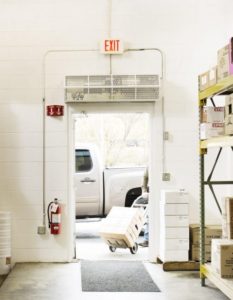
The California Health and Safety Code (CHSC) has mandated air curtains for more than 15 years on foodservice establishment back doors, including restaurants, hotels and other establishments that prepare and serve food. Insect-attracting dumpsters are typically near back doors, therefore the code’s goal is a chemical-free elimination of unsanitary conditions flying insects create near food preparation.
However, air curtain technology advancements in the last five years have gone beyond the back door. It’s not CHSC code-mandated, but restaurants and food service outlets are now preventing flying insect and energy losses at the customer entrance, drive-thru windows, and even walk-in cooler entrances.
But What is an Air Curtain?
- Air curtains consist of a metal box with highly engineered air blowers controlled by a switch that’s activated when the door opens.
- They’re typically mounted above the width of a doorway and disperse a steady air stream across the entire door opening. This “air seal” thwarts flying insects that can’t penetrate the airstream.
- Air curtains also have an energy-saving benefit, because they separate the outdoor and indoor environments, thus saving air conditioning or heating from escaping outdoors.
- An additional value is employee and customer air comfort in both winter and summer operation.
While appearance isn’t a major concern for service entry doors, the aesthetics of a visible 3 (L) x 12 (W) x 12 DJ-foot metal box mounted above a front door wasn’t favored so the industry now develops models that lay into the ceiling above the interior doorway and have multiple fan speeds for velocity and sound control. These architecturally recessed air curtains provide flying insect protection, but their ability to minimize energy losses from frequent patron door cycles is driving the trend of front door protection.
ENERGY SAVINGS PRODUCE PAYBACKS OF LESS THAN 1.5 YEARS.
Air curtain uses are becoming so popular that manufacturer’s representative, Preferred Marketing Group (PMG) installed front door, back door, and drive-up window demonstration models in its Chatsworth, Calif.-based, demonstration kitchen and education center. PMG, which has sold thousands of air curtains throughout its territory of California and Nevada, regularly invites customers to test demos of every imaginable type of restaurant equipment, including air curtains.
Specifically, PMG uses a three-foot-wide working architecturally-recessed model on the showroom’s front entrance and a three-foot-wide, UL-EPH listed, National Sanitation Foundation (NSF)-37 certified model on its back door. Both units are activated when its respective door is opened.
“We’re seeing a real interest in front door air curtains from both foodservice consultants and chain executives.”
-Tony Valvo, vice president, PMG.
Another recent air curtain development is the Drive-Thru Unit (DTU), which PMG has also installed on a drive-thru window mock-up in its education center. While unprotected drive-thru windows are a valid entry point for insects, the continual inhalation of idling vehicle emissions creates a respiratory hazard for drive-thru clerks, according to the Occupational Safety and Health Administration (OSHA) at its website where they recommend a “reverse-flow fan system” among other solutions.
Walk-In Coolers
Another new air curtain application is on the entry doors of walk-in coolers. Many foodservice and restaurant operators are unaware that the Energy Policy and Conservation Act (Section 312), mandates all walk-in coolers/freezers manufactured after Jan . 1, 2009 include either strip curtains, spring-hinged swinging vinyl doors or other air infiltration reduction methods. Air curtains require less maintenance, are more effective, have a longer lifespan, and offer a safe unobstructed view into the walk-in cooler.
One air curtain proponent is Richard Dieli, FCSI, a principal at institutional foodservice design and consultant firm Dieli Murawka Howe (DM HJ Inc., San Diego, Calif. Dieli has used all of the aforementioned applications in what may be the industry’s most diversified use of air curtains in one facility. Dieli specified air curtains for a military base commissary’s walk-up window, both the interior and exterior doors of a walk-in cooler, the front entrances, and of course, the code-mandated kitchen service door.
The recently-built 25,000-square-foot California-based foodservice/dining facility which serves 12,000 meals per shift includes a 30 x 50-foot walk-in cooler that has air curtains on both the exterior door shipments and an interior door for kitchen access. The walk-in cooler’s 5 x 10-foot exterior doorway prevents the infiltration of 70 to 80 percent of the ambient air, which can often surpass l00°F in the base’s desert location. The air curtain has a field-adjustable three-speed switch for different fan velocities. Besides significant energy savings that could result in an estimated payback within a year, it also reduces maintenance by protecting against coil freeze-ups.
Restaurants with smaller walk-in coolers can take advantage of the industry’s recently-developed walk-in cooler kits. Existing coolers are easily retrofitted with the specially-designed kit because it needs only electrical power hook-up to a control box that’s pre-wired to the air curtain and its magnetic reed door activation switch.
A walk-in cooler air curtain study was recently conducted by an Arby’s franchisee Donoghue & Pivirotto Enterprises Inc., Wexford, Pa ., which operates four locations. The company performed a two-week audited test on a 10 x 12-foot walk-in cooler in Butler, Pa. After outfitting the walk-in cooler entrance with an air curtain, the results state the refrigeration circuit’s compressor ran 1.75- hours less during one week–a 27-percent reduction in compressor run-time and equipment wear-and-tear, the latter which will also produce long-term maintenance savings. The improvement results in nearly 100 fewer operating hours per year for an estimated annual savings of $447 and a 1.6-year payback on a walk-in cooler entrance air curtain.
In an industry where operating expenses are rising due to energy costs, the air curtain can help prevent energy losses at both back and front doors, the drive-thru window and the walk-in cooler entrance, with additional benefits of flying insect prevention.
Posted on the NEWS on October 6, 2008
A new research study shows that air curtains are significantly more energy efficient than vestibules and can save commercial-industrial building projects tens of thousands of dollars in construction costs as vestibule substitutes.
Air Curtains: A Proven Alternative to Vestibule Design is a newly released, three-month-long research study funded by air curtain manufacturer Berner International. The certified results used computational fluid dynamic (CFD) analysis from second-party research-validation consultant Blue Ridge Numerics, Charlottesville, Va.
When compared to conventional automatic two-door vestibules, the study’s results confirmed that an air curtain/automatic door entrance combination is up to 10 percent more energy efficient in environmental separation performance, costs up to 75 percent less in labor and materials, and conserves 50-2,000 square feet of entryway floor space typically consumed by vestibule designs.
CONFIRMATION
“If you ask most engineers or architects if air curtains are more energy efficient or less expensive than vestibules, they probably don’t know for sure, but this study reveals what we’ve known for some time,” said Timothy Londeree, R.A., architect, David A. Levy and Associates, Akron, Ohio, a retail design and development firm that has specified air curtains on dozens of commercial projects to save clients construction costs.
Berner executives said they hope the certified research will open a dialogue between the industry and the International Energy Conservation Code (IECC). Currently, the IECC doesn’t accept air curtains as viable alternatives in its Air Leakage – Section 802.3. Thus, the research study is another example of Berner providing customers with custom solutions to real market issues.
“Our clients want to save operating costs by using air curtains and eliminate the $20,000 to $60,000 cost of vestibules in their store designs, but they also want to stay within the IECC code,” said Berner project engineer Phil Thomas, who oversaw the project with engineering manager David Johnson.
THE STUDY ALSO CONFIRMED THAT BUILDING OWNERS SAVE MORE ENERGY, CONSTRUCTION COSTS, AND FLOOR SPACE.
AIR CURTAINS:
- use less supplemental heat than vestibule heaters;
- help enhance employee comfort;
- reduce liability by maintaining drier entryway floors during inclement weather;
- help keep traffic flow unhindered;
- improves sanitation by reducing insect entry.
The culmination of energy and construction savings adds up to a one- to three-year payback for an air curtain, according to the study.
The Air Movement and Control Association (AMCA), Arlington Heights, Ill., a nonprofit organization that creates standards for, and tests/rates everything from air curtains to dampers, louvers, outside air grilles, fans, and other air-side HVAC equipment, hopes to change codes to address air curtains as a vestibule substitute. Armed with the research study, the association is currently lobbying code committees.
Architects, engineers, and specifiers can still comply with codes and use air curtains as vestibule substitutes, but it’s usually done at the local inspection level.
MORE ADVANTAGES
Another sometimes-overlooked advantage of air curtains is employee comfort. Because point-of-purchase (POP) stations typically are located near entryways for security reasons, POP employees don’t enjoy the same air comfort of their interior counterparts. Cashiers tend to get the brunt of unchecked wind in the absence of vestibules or air curtains.
In the case of vestibules, cold outdoor air can penetrate the entryway, especially when both sliding door entrances open simultaneously during heavy traffic periods. Supplemental space heaters, which can be costly to install and operate, temper the vestibule space air that infiltrates the POP area. Air curtains can be specified with built-in electric heaters or heating coils that are supplied by the building’s central heating supply loop to temper the air.
In the summer, hot, humid air infiltrates the space and makes work areas near doors uncomfortable for employees.
BEYOND VESTIBULES
Air curtains also have a variety of other applications. For example, the extension of the TD Banknorth Garden’s commuter foot traffic area 100 feet into the adjacent train shed of the Massachusetts Bay Transit Authority’s (MBTA’s) North Station was an energy-saving opportunity.
Architect Sasaki and Associates, Boston, and HVAC project engineer Jeff Fleishman, Cosentini Associates, Cambridge, Mass., were concerned with energy efficiency as much as aesthetics. Consequently, Sasaki’s idea of a 12-foot-high lobby/soffit design now presents an environment that’s comfortably separated from the outdoor air of the mammoth train shed via 12 air curtains at the mouth of 12 automatic sliding doors. During rush hour when the automatic doors are constantly open with passing commuters, the air curtains keep cold air from infiltrating the new train station lobby area at great savings to the building owner, Delaware North Companies Inc.
Summertime operation prevents hot, humid air from infiltrating the lobby space. Except for the gentler airstream at the entrance, commuters don’t notice the air curtains, which are flush-mounted above into the new lobby’s perimeter soffit.
Cosentini custom ordered factory-installed coil-filter combination options that all have hot water coils that tap into the soffit’s heating supply loop. The 95,600-Btuh coils supplement the new entrance area’s main HVAC system by providing thermostatically controlled heating near the door areas when needed.
Each air curtain also includes a control package, which includes a thermostat; three-speed fan with maintenance access from an onboard control panel; a timer delay function; and a low-voltage relay for tapping into direct digital control (DDC) building automation systems.
MCCORMICK PLACE
Another innovative use of air curtains is Chicago’s new McCormick Place West convention center. When officials of the Metropolitan Pier and Exposition Authority (MPEA), which owns and operates the facility, were presented with energy conservation estimates of $70,000 annually and equipment cost paybacks of less than two years, choosing air curtains looked like a good thing.
Air curtains were one of several energy-conserving technologies that helped the project achieve two of its Leadership in Energy and Environmental Design (LEED) points from the U.S. Green Building Council (USGBC) in the Optimized Energy Performance category.
The $850 million exposition facility has more than 375 linear feet of freight and pedestrian doors, which are typically open 10 to 14 hours daily during the five-seven days of setup prior to major winter events. Many air curtain manufacturers can perform an energy savings estimate for customers by gathering and calculating dozens of site conditions data. Some of McCormick Place West’s data calculations considered a 26-week heating season, with each door open 10 hours weekly for a total of 260 hours annually. Besides the annual savings and payback, there was also a calculated hourly savings of $269.79 when all the doors are open simultaneously.
Air curtains also have an impact on indoor air comfort in the facility’s 470,000 square feet of open exhibition space. Without the air curtains on all large roll-up doors and main doors, temperatures would drop dramatically during set-up and tear-down, and it would require a minimum of 24 to 48 hours to regain the target temperature of 73° to 75°F for an event, according to Susan Van Klompenburg, senior mechanical design engineer, A. Epstein and Sons International Inc., which performed consulting engineering for the McCormick Place West expansion as a member of the joint venture, McCormick Place Design Team, Take II LLC, Chicago.
Furthermore, employee air comfort can affect productivity significantly. Shows are set up more efficiently in cold, wintertime months at McCormick Place West because employees are more comfortable. Moreover, forklifts can pass freely through freight doors without waiting for them to cycle.
IN THE STUDY
Thomas and Johnson recorded and compiled hundreds of statistics based on the geometry and scale of conventional vestibule architecture used by three national pharmacy chains. Three building configurations (vestibule only, air curtain only, and vestibule and air curtain) were simulated with wintertime ambient temperatures of 20°F under a variety of wind loads and traffic frequencies. The dozen scenarios were 3-D modeled in SolidWorks 2007 and launched into CFdesign upfront CFD software by Blue Ridge Numerics.
CFdesign was chosen because of its ability to model moving solids in numerous scenarios and to allow recorded measurements in a multitude of scalar and vector quantities in a precise and repeatable manner. Similar test results would have been impossible with other testing methodology such as simple mathematical equations.
“Physical lab testing procedures might have given a similar result, but CFD analysis cut test time by as much as 60 percent, not to mention the additional production costs of building a vestibule test site,” said Jason Pfeiffer, director of engineering services, Blue Ridge Numerics, which is a world leader in upfront CFD and engineering services.
For more information, visit www.berner.com.
Sidebar: Air Curtains and LEED Credits
Berner air curtains, which have been certified by the Air Movement and Control Association (AMCA), can help to achieve Leadership in Energy and Environmental Design (LEED) Energy and Atmosphere points, as well as Indoor Air Quality points. Here are a few of the main areas in which the proper use of an air curtain can help a building achieve LEED points.
Energy and Atmosphere Points (EA Credits 1)
Credit EA 1 – While air curtains are not a major part of an HVAC system, used properly, air curtains can increase a space’s energy efficiency when the doors are opened – decreasing energy consumption and increasing occupants’ comfort. For this credit (good for up to 10 points), the LEED certification process requires a whole building project simulation that shows the percentage improvement in the proposed building performance rating compared to the baseline building performance rating per ASHRAE/IESNA Standard 90.1-2004.
Indoor Air Quality Points (EQ Credits 6.2 and 7.1)
Credit EQ 6.2 – Air curtains provide a high level of thermal comfort system control by individual occupants or by specific groups in spaces that are surrounding openings (i.e., loading dock doors, customer entryways) to promote the productivity, comfort and well being of building occupants (Thermal Comfort: Controllability of Systems, Credit 6.2).
Credit EQ 7.1 – By preventing thermal drops or rises due to a system’s reaction to cross-contamination of airstreams near an open doorway, air curtains can help an HVAC system comply with ASHRAE Standard 55-2004, Thermal Comfort Conditions for Human Occupancy. For example, cold winter air near the door may kick the heat on, causing spaces away from the door to be overheated (Thermal Comfort: Compliance, Credit 7.1).
Innovation in Design Points (ID Credits):
Credit ID 1-1.4 (good for 1 point) – Because doors are already closed when a building is commissioned, air curtains are not always included in the mechanical testing process. However, when used properly, air curtains help to increase energy performance (decrease energy use), and it is common to see a payback period of one-two years depending on location and use. It has been recommended that if the benefits of air curtains are not being captured elsewhere by the LEED-NC Green Building Rating System, air curtains should be submitted for this credit.
Some air curtains can also be used for insect control. If a client is putting together a Low Environmental Impact Pest Management Policy to minimize the use and cost of chemicals, air curtains can help achieve Indoor Environmental Quality points in the LEED for Existing Buildings Rating System.
Indoor Environmental Quality Points (EQ Credits 10.4 and 10.5)
Credit IEQ 10.4 and 10.5 – Low Environmental Impact Pest Management Policy.
For more information, visit www.usgbc.org.
Published in the February 2016 issue of HVAC Products.
Berner International Corp. has recently introduced the Berner Air Curtain Energy Savings Calculator, a user-friendly, online energy savings estimation tool accessible by any web browser for quick payback calculation and air curtain selection.
The time-saving energy-savings calculator is the most powerful air curtain energy savings computational tool in the industry because it also incorporates air curtain selection and return-on-investment calculations. Thus, the user gets energy savings, a payback in years, and an air curtain model choice, all automatically calculated and saved to a URL for revisits, sharing with colleagues, or making client presentations. Each calculation allows for the comparison of two or more Berner air curtain models’ effectiveness ratings and ROI energy savings for comparative purposes.
User- and Mobile-Friendly
The program’s user-friendliness enables facility managers, architects, consulting engineers, contractors, and Berner’s manufacturers’ representatives to input door dimensions, use times, local energy rates, and other data. Users can choose between National Weather Data (BIN Data) and associated utility rates or manually enter their own weather data. Users can manually select an air curtain model or use the embedded air curtain selector program.
Another feature is the Berner website’s mobile-friendly responsive design, which automatically resizes the program for scalable viewing use on smartphones, tablets, conference room screens, or any other web-browser capable device.
The final energy savings estimate is typically a conservative number because the program applies penalized energy scenarios for mounting height, building opening location, and wind resistance ability. Therefore, building owners will many times find more favorable air curtain energy savings than the program’s pre-installation calculation.
Developed in-house throughout 2015 by Berner’s engineering, marketing, and sales departments, the program is based on loads calculated from generalized customer input, TMY2 weather data, and ASHRAE calculations. The air curtain efficiency used to determine the payback period is based on generally accepted theory, laboratory and field tests.
Other program benefits are:
- Inputs are easily revised by reopening the URL and changing input data or using a different air curtain model.
- Inquiries are sent confidentially to the location’s respective manufacturer’s representative for sales follow up.
- Includes a wide variety of drill-down opening selections ranging from exterior to interior doorways and walk-in cooler/freezers. Doorway types range from food service, hospitality, education, healthcare and retail to industrial dock doors.
While the program is ideal for energy savings calculations, it doesn’t account for the many other benefits of air curtains offers, such as protecting occupant comfort and the infiltration of flying insects, dirt, fumes, cigarette smoke for optimum indoor air quality and air comfort.
Published in Medical Construction & Design, January/February 2013
HVAC trends point toward an increasing amount of consulting engineers who specify air curtains for healthcare applications. Instead of common shipping or foodservice back door air curtain applications to prevent flying insect infiltration, air curtains have expanded to the front door, emergency room door, and even foodservice walk-in cooler doors to reduce energy costs. Click Here for full article.